







What a fresh cut decides
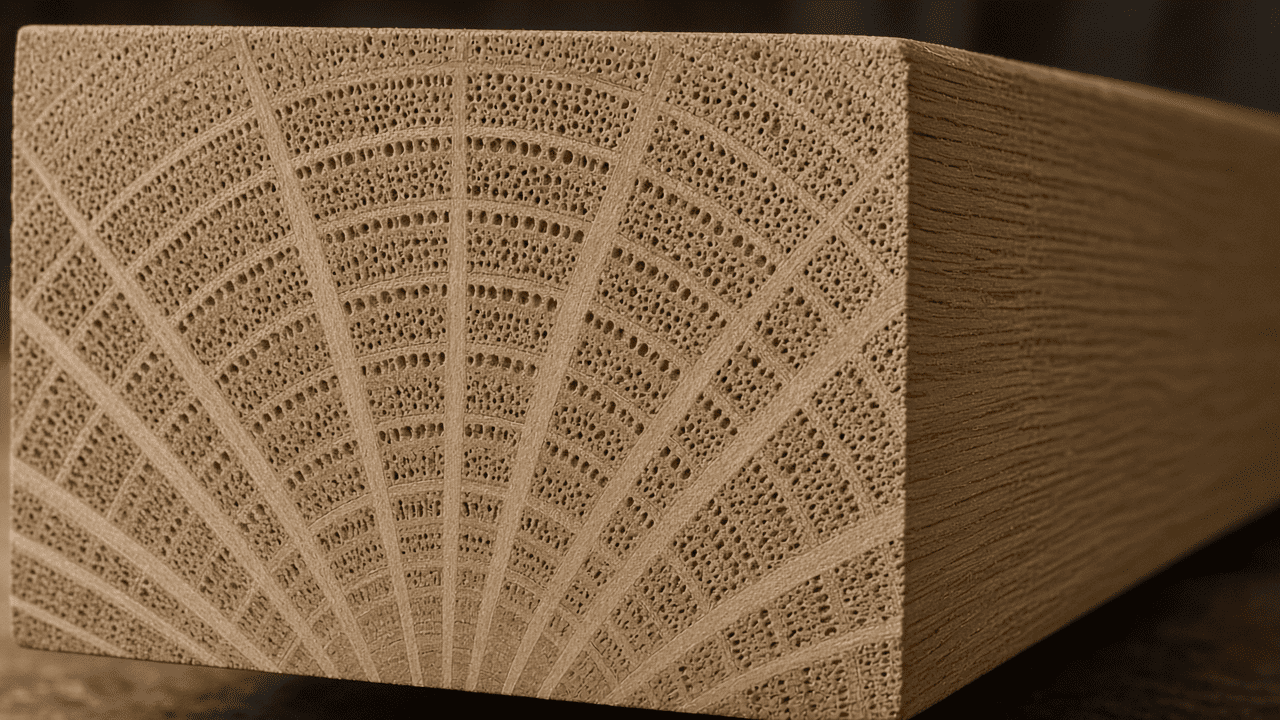
How to identify oak wood is an end-grain job. On a smooth cross-section, ordinary commercial oak (Quercus) shows two things at once: a band of large earlywood pores that drops abruptly to much smaller latewood pores, and rays so wide they read as pale ribbons crossing those rings, with narrower rays between them. Purdue’s wood-identification notes treat those wide rays as easy to see without a lens. Ring-shaped pores by themselves also occur in ash, chestnut, elm, and hickory. Wide rays by themselves also occur in beech. The pair is what makes the usual oak call.
Color, stain, and a cathedral pattern on the face do not finish it. Trade “red oak” and “white oak” are groups of species, not a promise that the board is Quercus rubra or Quercus alba. Stop if the only surface you can see is sealed face grain. Pause if the wood is an evergreen live oak: southern live oak (Quercus virginiana) is recorded as diffuse-porous, with large pores and very wide rays, so the ring test fails while the ray test still holds.
Check the end before the face
Cut a clean transverse surface with a sharp knife. Rough saw marks and packed dust hide both pores and the shiny plugs called tyloses. A 10× hand lens is the working magnification for this kind of check; the naked eye is enough for the widest oak rays, not for latewood pore size.
- Look for porosity. Pass if each growth ring has a distinct row of large earlywood pores and an abrupt change to tiny latewood pores. That is ring-porous wood. Stop if pores stay small and fairly even across the ring: that is diffuse-porous, the pattern of maple, and also of beech. Pause if the change in pore size is gradual. Slow-grown ring-porous wood can also look confusing, because the rings are so narrow that latewood almost disappears and the earlywood bands sit on top of each other. Do not call that diffuse-porous.
- On the same surface, look for rays. Pass if some rays are wide enough to see as light lines running across the rings, with finer rays between them. Oak has both sizes. Stop if every ray is a hairline. Ring pores without those wide rays are not enough for oak. Ash is the common yard look-alike in that bin; chestnut (Castanea) is ring-porous too, and its rays are exclusively one cell wide, so they do not form oak’s ribbons. Elm and hickory are ring-porous as well and lack oak’s very wide rays.
- Only after both checks pass, use the face as a confirmation, not as the test. A flatsawn or plain-sliced surface shows cathedral arches from the earlywood pores, and the ray ends are easy to miss. A quartersawn face cuts along the rays and shows fleck. Purdue’s red-oak lumber note points out that flatsawn oak hides the rays next to the coarse pores, while quartersawn oak shows them. Fleck supports the end-grain call. It does not replace it. Beech (Fagus) is diffuse-porous, yet its largest rays are conspicuous and it can show fleck on a radial face. American beech pores stay small and numerous; they do not form oak’s earlywood ring.
If step 2 fails and the wood is ring-porous with only fine rays, you are no longer identifying oak. The oak versus ash wood page is the project comparison for that pair. This page stops at “oak or not.”
Southern live oak is diffuse-porous in the Wood Database account: large solitary pores, abundant tyloses, and very wide rays, without the classic earlywood ring of white oak. Other evergreen oaks can look weakly ringed or semi-ring-porous. If a heavy southeastern board has obvious wide rays but no clear pore ring, leave it as “oak, not the usual lumber group” until the end grain is clean enough to judge porosity. Do not force it into red oak or white oak lumber by color.
How to identify oak wood when the end is gone
Veneer, plywood faces, and fully painted furniture often have no transverse surface. Rotary-cut and plain-sliced veneer are tangential faces, so you see cathedral figure or, on quarter-sliced oak, fleck. That figure is shared. Ash veneer is sold in cathedral and straight-grain patterns. Beech and sycamore can show ray fleck. A stained face can be made to read as oak even when the end grain would not.
In that situation, how to identify oak wood stays unfinished. You can say the face is consistent with oak if you see coarse open grain plus either strong cathedral figure or real ray fleck, and you can rule out tight diffuse-porous woods such as maple. You cannot separate oak from ash, chestnut, or beech, and you cannot place the board in the red or white group. If a hidden end, an offcut, or the back of a panel can be knifed, go back to the end-grain order. If it cannot, stop at “possible oak” and buy or repair on that limit.
Red oak group or white oak group
Run this only after the end grain has already said oak, and only on heartwood. Sapwood of white oak often lacks the plugs that heartwood shows, so an open pore in pale sapwood does not prove the red oak group.
On a dust-free earlywood pore, white-oak-group heartwood is usually packed with tyloses. Red-oak-group pores stay open. Blow the dust out before you call a pore plugged. Sawdust is the usual false tylosis. The Wood Database comparison treats tyloses as the most reliable shop split, with two limits: the surface must be heartwood, and chestnut oak (Quercus montana) stays in the white oak group even though its pores are often open, like red oak. A U.S. Forest Service handbook notes the same chestnut-oak exception. Open pores therefore mean “not the tight white-oak pattern,” not “certainly red oak.”
Ray length on the face is a backup, not a ruler you can trust on one streak. In that same comparison, red-oak-group rays on the face are usually short, often about an eighth to a half inch and rarely past about three-quarters of an inch to an inch, while white-oak-group rays more often run longer than about three-quarters of an inch. Measure several rays. One long streak does not reclassify the board.
Mills sometimes separate the groups with a nitrite color reaction on heartwood. That is a specialized test, not a kitchen step, and it does not work on sapwood. For a board in the shop, stay with clean end grain.
Species inside either group are not separable with these checks. Trade red oak may include many eastern species; trade white oak is a group as well. Latewood pores in white oak tend to be too small to count as individuals, while red oak latewood pores are easier to see one by one, but that is a lens impression, not a species name.
A stained floor board
A common failure is a refinished floor or a salvage board whose face has been stained to a uniform brown. Work an inconspicuous end, under a baseboard or on an offcut, not the show face.
Knife the end, blow it clean, and apply the two passes. Wide rays plus a clear earlywood ring: it is oak in the usual sense, and the stain was irrelevant. Ring pores and only hairline rays: it is not oak; ash is the frequent substitute on a stained face. Small even pores plus wide rays: think beech, or a live oak if the pores are large and the board is unusually heavy, and do not call it red oak because the finish looks red. If it is oak heartwood and the earlywood pores are open, treat it as red-oak-group for any job that needs liquid-tight or decay-resistant heartwood, unless you have independent evidence it is chestnut oak or another open-pored white oak. If the pores are tylosed, the white-oak pattern is the working call. Either way, the floor’s color is not evidence.
FAQ
Can I identify oak from a photo of the face?
Only as a maybe. Cathedral grain and brown stain are shared with other ring-porous woods. A photo helps when it shows a clean end with both the pore ring and the wide rays, in focus, with dust blown out.
Are all oaks ring-porous?
No. The commercial red and white oak groups used as lumber in eastern North America are ring-porous. Southern live oak is the standard exception in wood-anatomy references: diffuse-porous, with wide rays still present. Do not apply the ring test to every tree sold locally as live oak without looking.
Does ray fleck prove quartersawn oak?
It proves large rays were cut on a radial face. Oak does that dramatically, and white oak is the species mills prefer when they quarter-saw for fleck. Beech and sycamore can fleck too. Confirm porosity on the end before you pay an oak price for fleck alone.
Why not just weigh the board?
Oak is a heavy hardwood, but weight overlaps ash, beech, and hickory, and moisture changes the number. Use weight only as a pause if a “live oak” candidate feels light and the rays are fine.
Bottom line
How to identify oak wood means a clean cross-section with an earlywood pore ring and rays wide enough to see, then a heartwood pore check if you need the red or white group. Face grain, fleck, and stain come after that, or they leave the call unfinished. Live oak and chestnut oak are the two pauses that break a one-line rule: one lacks the ring, the other can lack tyloses and still sit in the white oak group.