






Short answer
Oak vs ash wood is not decided by hardness alone. North American white ash, northern red oak, and white oak cluster within about seventy points on the Janka scale (roughly 1,290 to 1,360 lbf at twelve percent moisture content), so dents, chair legs, and floor wear look similar in daily use. The split that matters is environment and anatomy: white oak heartwood resists decay and blocks liquids with tyloses in its pores; ash and red oak heartwood do not. Ash flexes and absorbs shock better, which keeps it in bats, oars, and long tool handles, while oak’s medullary rays give quartersawn figure ash cannot copy.
For a quick commit, answer three questions in the picker section below. If you are buying unmarked salvage or a bin labeled “hardwood,” plan on end grain. Face grain plus stain is where ash is often passed off as oak, and where a wrong species choice hurts outdoors.
What actually separates oak and ash
Both are ring-porous hardwoods with coarse, open grain on the face. At a distance, pale ash can sit next to warm-toned oak and look like the same family, which is why extension wood notes describe ash as a flat-sawn oak substitute when stained.
Durability in service follows tannins and tyloses more than Janka. White oak is rated very durable in wood-database and handbook summaries and is standard for tight cooperage and exterior work where heartwood stays dry-ish. White ash and red oak heartwood rank as perishable or only slightly durable outdoors. Indoors, with stable humidity and a good finish, ash performs fine for furniture and floors.
Mechanical character differs at the margins. Ash runs a little lighter than oak and scores slightly higher in bending strength in handbook averages; red oak is a bit stiffer, which affects shelf sag more than dents. Ash’s straight grain and shock resistance favor bent handles and impact loads. Oak is strong but less forgiving under sudden shock, so striking-tool handles usually move to ash or hickory instead.
Movement matters on wide flatsawn panels: red oak tends to swell slightly more across the grain for a given moisture swing than white ash in handbook coefficient comparisons. Build allowance into tabletops and wide floor runs regardless of species.
Three questions to pick oak or ash
Use this order so you do not choose figure before you know whether the piece can survive moisture or impact.
- Will the part see rain, soil contact, or unfinished heartwood outdoors? If yes, choose white oak heartwood (or another decay-resistant species), not ash and not red oak heartwood. Pause if only sapwood is available; sapwood of any species is poor outdoors.
- Does the part take repeated impact or need steam-bent curves (handles, boat oars, bent chair bows)? If yes, lean ash when decay is not an issue. If the part is a hammer handle subject to extreme shock, hickory still wins, but ash is the usual ash-or-oak answer.
- Do you want ray fleck or a pale, even field? Quartersawn white or red oak for fleck; ash for a clean, straight-grained Scandinavian look that stains evenly without tannin blotching.
When all three answers are “interior furniture, no shock, either look,” either species works. Choose on color, quoted price, and what your yard actually has in thickness.
| Project | Lean toward | Main reason |
|---|---|---|
| Outdoor bench or planter | White oak | Decay-resistant heartwood; ash and red oak fail outdoors |
| Barrels or liquid-tight cooperage | White oak | Tyloses block pores; red oak and ash leak |
| Baseball bat, axe handle, oar | Ash | Shock and bend; oak is brittle under impact |
| Quartersawn cabinet door with fleck | White or red oak | Large rays; ash has no ray fleck |
| Light contemporary interior table | Ash | Pale color, even stain, straight grain |
| Wide flatsawn floor in dry rooms | Either | Similar hardness; compare color, price, movement |
Yard ID when oak vs ash wood is unlabeled
Run these checks on a freshly exposed surface. Stop early if a step fails; do not override end grain with face color alone.
| Step | Surface | Pass (species direction) | Stop | Pause |
|---|---|---|---|---|
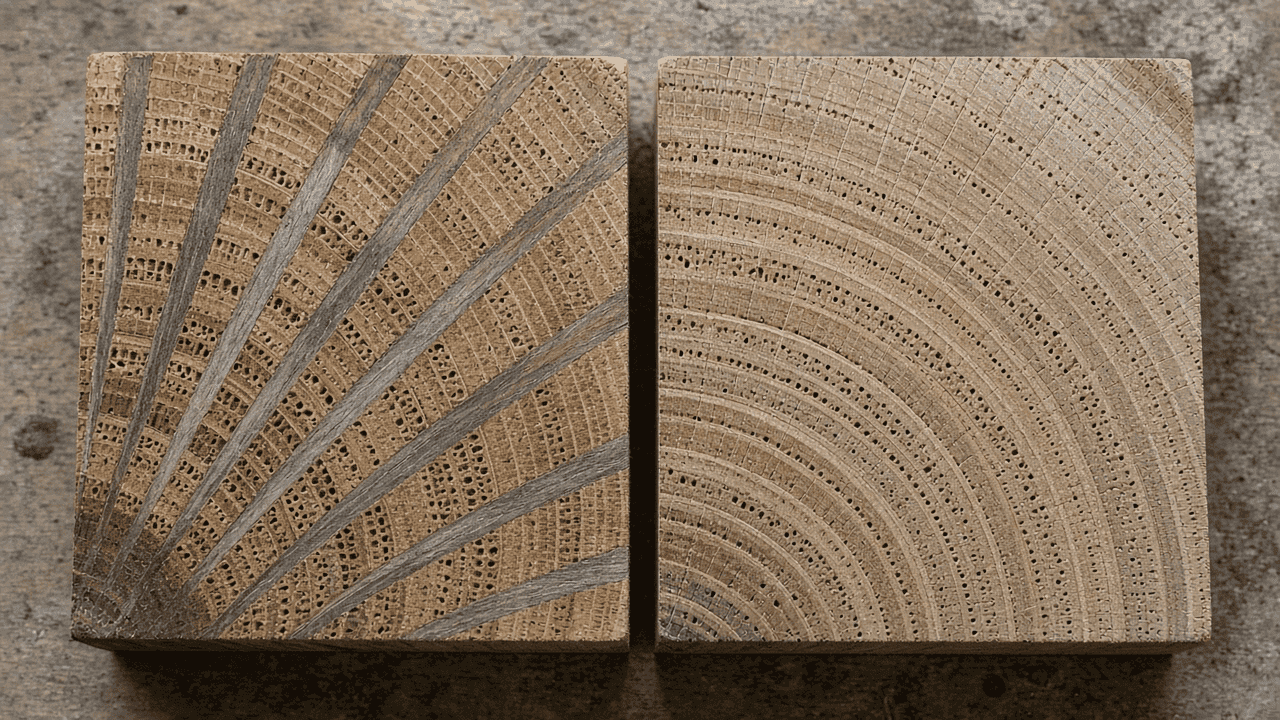
| 1 | End grain cross-section | Bold wide rays crossing rings visible to the naked eye → oak | Diffuse pores or only fine rays → not oak (could be maple, birch, many others) | Semi-ring-porous hickory-like rings — not this article’s ash/oak pair |
| 2 | Same end grain | Ring porous with large earlywood pores; if latewood pores are tiny and crowded with tyloses visible in earlywood → white oak group | Ring porous but rays narrow like lines hard to see → ash | Red oak: ring porous, wide rays, no tyloses — still oak, not ash |
| 3 | Quartersawn face or ray fleck | Silver-gold fleck on quartersawn face → oak | No fleck on quartersawn; end grain already says ash | Stained face mimicking oak — trust step 1–2 or cut a hidden end |
Ash end grain shows ring porosity like oak but lacks oak’s wide rays. That single trait is what forest-products teaching uses to keep ash out of “quartersawn oak” bins. After the board is oak, red-oak-group versus white-oak-group still needs latewood pores and tyloses on the same end grain; ray height alone does not finish that split.
If the wood came from a felled yard tree rather than a lumber sticker, confirm the tree was an ash (Fraxinus) or oak (Quercus) before you trust color. Opposite branching and paddle samaras point to ash on the white ash tree guide; oaks carry acorns and alternate buds. Cut lumber no longer shows those clues.
Red oak, white oak, and ash
“Oak” in a big-box aisle often means northern red oak group lumber. Comparing ash to that grade is fair for hardness and indoor furniture, but unfair for outdoor life: red oak and ash both lack white oak’s decay package. White oak resists rot and seals liquids; red oak does not, despite similar Janka to ash.
Tannins explain part of the indoor finishing gap. Oak can react with some water-based topcoats unless you seal or choose compatible finishes; ash accepts stain more predictably because it is low in tannin. Oak also reacts with iron when wet, which matters for outdoor fasteners and wet-bar tops.
Do not assume English or live oak outside the usual North American commerce groups without checking end grain; the oak ID article covers when ring-porous southern live oaks break the textbook oak-lumber pattern.
Supply and the emerald ash borer
White ash remains in eastern North American commerce but is under heavy pressure from the emerald ash borer, first detected in Michigan in 2002. Wood-database lists Fraxinus americana as critically endangered on the IUCN Red List because of projected population collapse, and much ash lumber now comes from salvage removals. Federal domestic quarantine rules changed in 2021, but firewood and log movement restrictions still vary by state, which affects local price and availability more than dried, debarked furniture stock.
Oak species are abundant by comparison. If your picker ties on interior use, availability and quote often decide ash vs red oak; if white oak is required for outdoor or fleck, budget accordingly.
FAQ
Is ash harder than oak?
Roughly the same for practical purposes. Handbook-side hardness runs about 1,320 lbf for white ash, 1,290 for northern red oak, and 1,360 for white oak at twelve percent moisture content. Choose by decay, figure, and impact instead.
Can ash replace oak on furniture?
Yes indoors when you want a paler, straighter look and even staining. No when you need quartersawn fleck, outdoor heartwood durability, or a liquid-tight cooperage stave. Stained flat-sawn ash has long passed as oak on exposed faces; verify end grain on salvage.
Is ash good for flooring?
Ash floors are valid in dry interior spaces and read lighter and more contemporary than red oak. White oak is the safer pick where spills and seasonal moisture swings are harsh, because of tyloses and decay resistance, not because ash is soft.
Why do handles use ash if oak is “strong”?
Strength under steady load favors both woods. Ash wins where the fibers must flex and return after impact. Oak’s ring-porous structure is less forgiving under shock, so tool and sport traditions favor ash or hickory.
Bottom line
Oak vs ash wood converges on hardness indoors but diverges on rays, decay, tyloses, and impact. Pick white oak when water or weather hits heartwood; pick ash for shock, bend, and pale straight grain; use red oak when you want warm interior oak character without paying white-oak prices. At the yard, let end-grain rays—not stain—make the call, and follow the oak ID guide when you already know the board is oak but not which commerce group.