







Names and summary
Lemon scented gum tree identification is a scent call on a smooth-barked bloodwood, Corymbia citriodora, not a match for every trunk sold as spotted gum. Crush a fresh adult leaf. A clear lemon or citronella smell, with pale bark that sheds in thin flakes and with narrow alternate leaves, is the working lemon-scented gum. The same scientific name is also used for an unscented form, subsp. variegata. That tree can carry a correct species label and still be the wrong common name.
Tags that still read Eucalyptus citriodora are the older name for this bloodwood, not a second species. The epithet citriodora also belongs to lemon myrtle, Backhousia citriodora, a smaller tree with opposite leaves. Smell alone does not choose between those two plants, and a nursery line that says only “lemon” does not either.
Use the lemon-scented common name only when the crush is strongly lemon and the trunk is smooth and only weakly mottled. If the leaf is unscented and the bark is patchy, stop at spotted gum. That stop covers Corymbia maculata and the unscented C. citriodora form. Forcing “lemon-scented” onto that tree is the usual mistake.
How to recognize
-
Crush one fresh adult leaf from the crown, not a dried scrap. Pass when the smell is plainly lemon or citronella. Stop the lemon-scented common name when the crush is unscented or only faintly resinous, and keep the tree in the spotted-gum group. Pause on a fallen or heat-dried leaf. A blank smell there is not a verdict, because that sample is a poor stand-in for a fresh crown leaf.
-
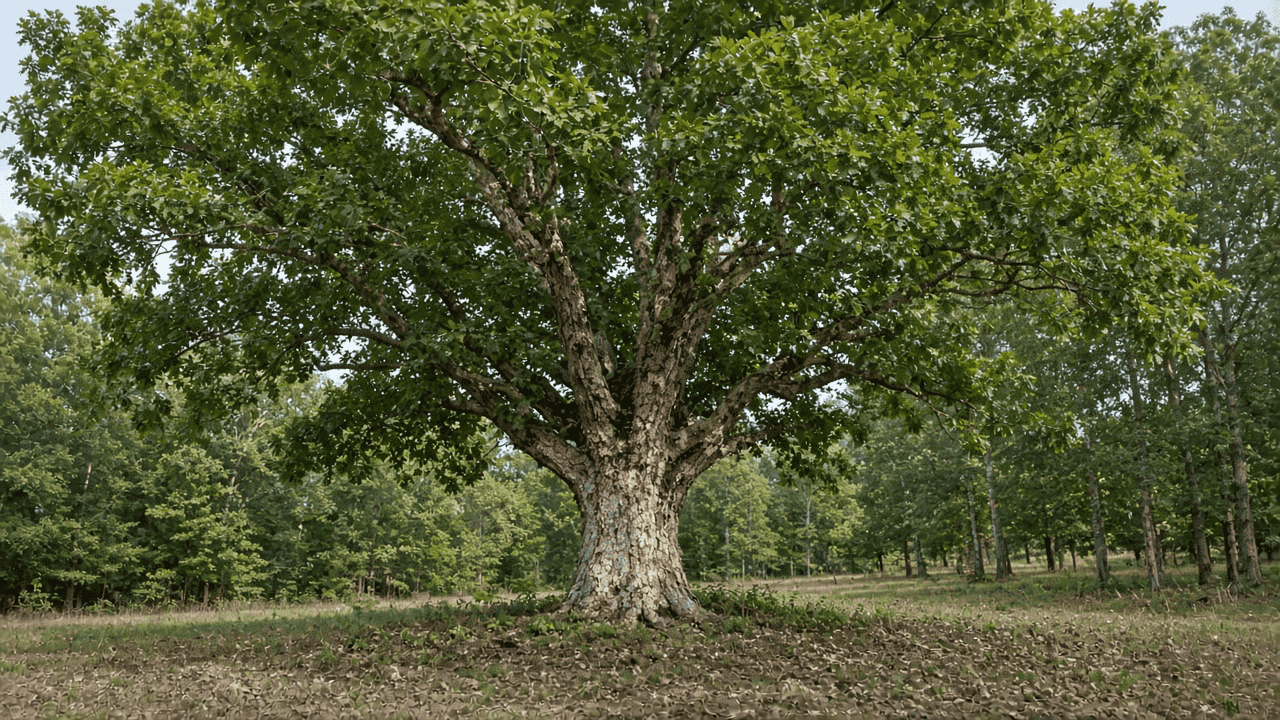
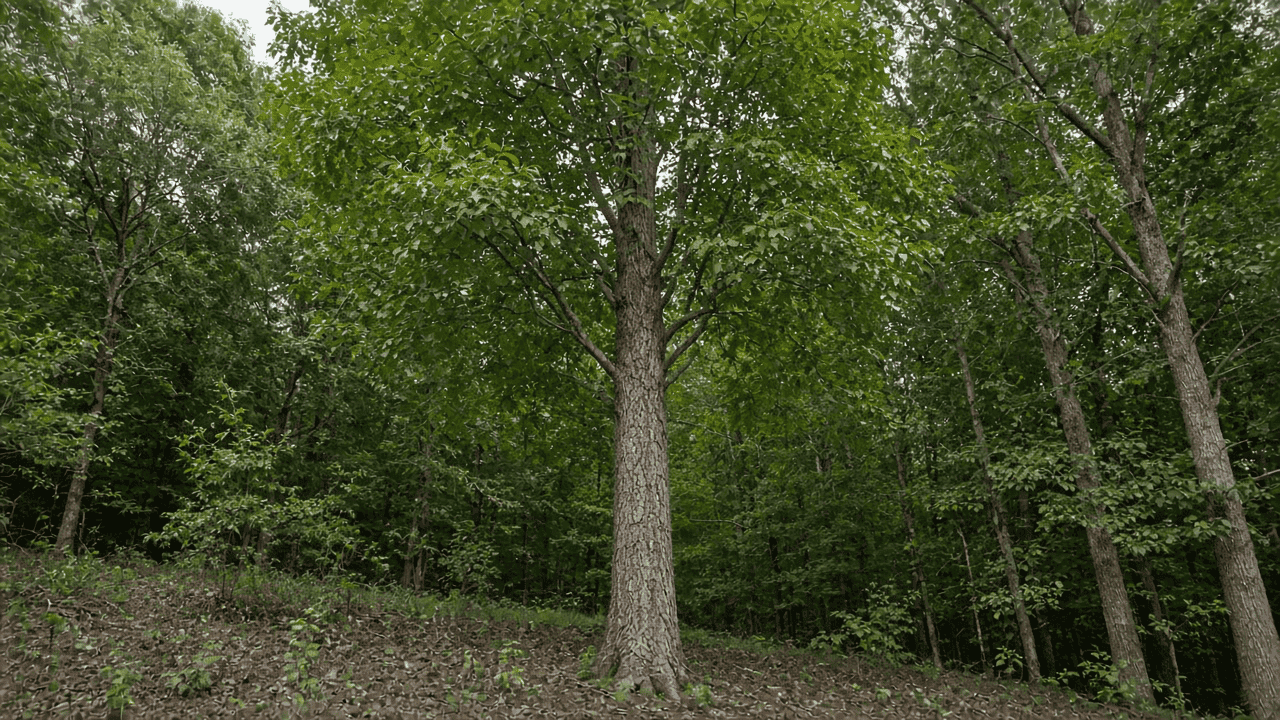
Look at bark from the base into the crown. Pass when it is smooth throughout, white, pink, or coppery, often powdery, and it sheds in thin curling flakes, with little mottling. Stop if dark, rough ironbark persists on the trunk and small branches. A lemon smell on that bark is lemon-scented ironbark, Eucalyptus staigeriana, not this gum.
-
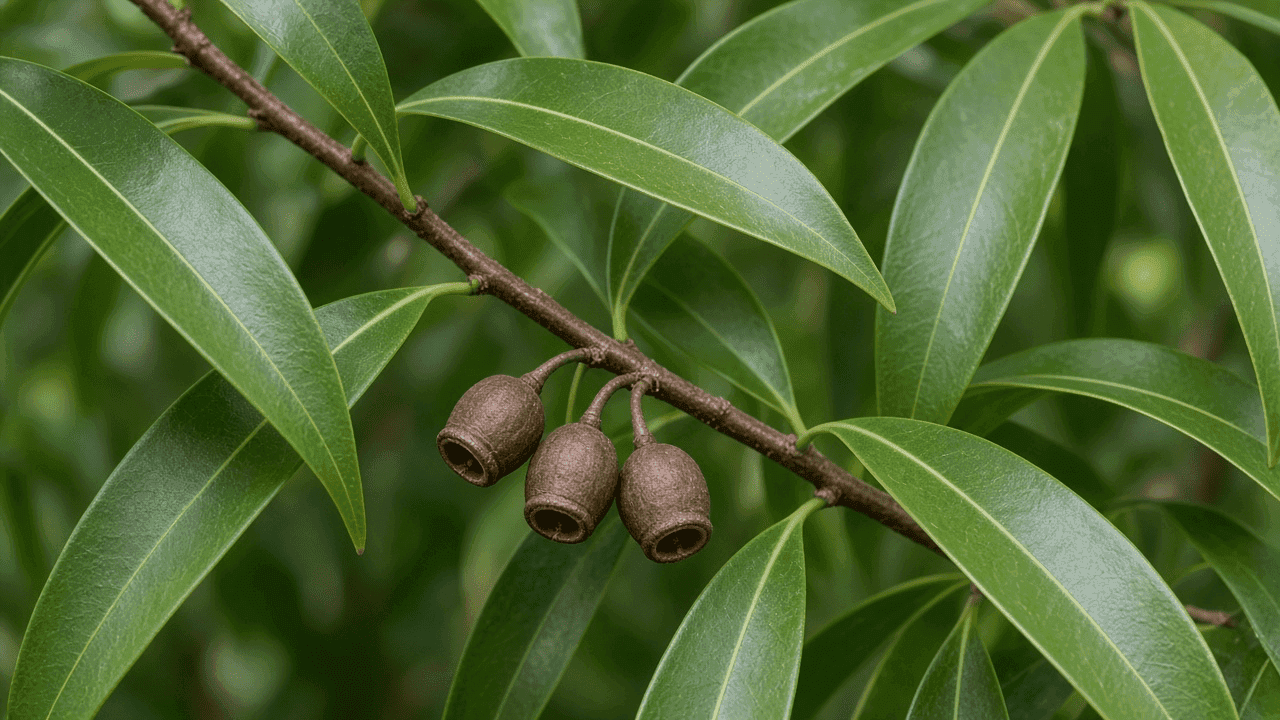
Use a crown twig, not a coppice shoot, for arrangement and shape. Pass when adult leaves are alternate, glossy, the same green on both sides, and narrowly lance-shaped to slightly sickle-shaped, often about 10–23 cm long and about 0.6–2.8 cm wide. Stop if mature leaves stay in opposite pairs and the side veins run lengthwise. That pattern is lemon myrtle.
-
If the crown is out of reach, check low regrowth. Pass toward this bloodwood group when juvenile leaves feel rough or bristly and the stalk attaches on the underside of the blade for many nodes. Pause if that regrowth is already smooth and you still cannot crush a fresh crown leaf. Rough juveniles support the spotted-gum group; they do not prove the lemon chemotype.
-
When buds or woody fruit are in reach, check the cluster. Pass when buds are in threes inside a branched head and the fruit is a stalked urn or barrel, about 0.8–1.5 cm long and 0.7–1.2 cm wide, with three valves sunk inside. Pause if the crown has neither buds nor fruit. Flowering has been recorded in many months, so an empty visit is normal.
-
Set the name only as hard as the evidence. Pass “lemon-scented gum” when steps 1 and 2 agree and step 3 or 5 supports them. Pause at “spotted gum” when scent is missing. Do not separate C. maculata from unscented C. citriodora on a street tree unless you can compare seedling leaf bases. Those differences are slight.
Scent comes first because pale trunks and urn-shaped nuts are shared across the spotted gums. Arrangement removes a lemon-smelling myrtle before bark colour is debated. Fruit supports a bloodwood cluster of three and does not put the lemon name back on an unscented leaf. That order is lemon scented gum tree identification on the tree in front of you.
A photo, including the illustration below, cannot replace a crush test on a fresh leaf from the tree in front of you.
The frame below is an editorial illustration of adult leaves and urn-shaped fruit. It is not a voucher specimen and is not enough to confirm an identification.
Similar species
| Name | Safe? | One difference |
|---|---|---|
| Spotted gum (Corymbia maculata) | Not assessed | Crushed leaves are never lemon-scented; bark is more clearly spotted |
| Unscented C. citriodora (subsp. variegata) | Not assessed | No lemon scent and mottled bark; juvenile leaf bases stay peltate longer |
| Lemon myrtle (Backhousia citriodora) | Not assessed | Adult leaves opposite; smaller bushier tree of rainforest |
| Lemon-scented ironbark (Eucalyptus staigeriana) | Not assessed | Rough dark ironbark on the trunk and branches |
| Large-leaved spotted gum (Corymbia henryi) | Not assessed | Coarser leaves and larger buds and fruit; sizes still overlap |
The row people get wrong is the unscented spotted trunk. State floras treat lemon smell as the reliable split from C. maculata, and Victoria treats crushed-leaf scent as the only reliable split between the two C. citriodora subspecies. Leaf width and mottling only back that crush up. C. henryi is a size overlap from the Brisbane region south toward Grafton: coarser leaves and larger buds are a hint, not a clean rule when the measurements overlap.
At a glance
Identity
Form
Season and place
Care
Where and when
Taken broadly, the species grows in dry forest and woodland on lighter loams and skeletal soils, from Cooktown and Lakeland Downs in Queensland south to about Coffs Harbour, and inland toward Hughenden, the Carnarvon Range, and Chinchilla. The strong-lemon, weakly mottled pattern is the northern one. Plantings are common outside that map, including southern Australia and New Zealand parks. For those trees, lemon scented gum tree identification still uses the crush, not the postcode.
Bark colour shifts as flakes shed, so one visit’s mottling is a weak veto. A high crown or a cut-back hedge hides the adult check: regrowth can be opposite, rough, and peltate, which only keeps you inside the spotted-gum group until you can crush a fresh crown leaf. An empty crown is normal, because flowering is on record across many months rather than one season.
Care guide
Give a full-sized tree room before you plan any feeding. Wild trees can exceed 40 m and reach 50 m. Gardens more often see 20–30 m, and young plants can add as much as 2 m a year, so a sapling can be about 20 m within ten years. Plant in an open, sunny spot on sandy loam or well-drained gravel. Established trees are rated only moderately thirsty, tolerant of dry spells, and mildly frost tolerant in warm conditions, and a poor fit on saline soil.
Keep the trunk off roofs, cars, and paving. Limbs can drop with little warning, including in hot weather, and roots have lifted driveways and blocked drains. Train a young tree to one leader and cut unwanted branches back to the collar. Cutting it back to hold rough juvenile foliage at nose height keeps the scent in reach. It does not turn the plant into a courtyard tree. Water through establishment. After that, space and falling wood matter more than a feed calendar.
Escapes from plantings
A correct name does not keep seed on the planting site. Cultivated trees have naturalised near Mundaring in Western Australia, in suburban Sydney, and in Victoria, and the Kings Park avenue in Perth is cited as a local weed source. Along the Georges River in Sydney, saplings from plantings have formed thick regrowth. Near bushland, pull those seedlings. The name is not an order to remove every mature avenue tree.
History
Hooker published the tree in 1848 as Eucalyptus citriodora. Mueller later called the lemon smell only a variety of spotted gum. In 1995 the bloodwoods were moved to Corymbia, and an unscented plant was split off, then ranked again as C. citriodora subsp. variegata because it lacks the lemon smell. Some guides still print Eucalyptus. The genus on an old label does not change the crush, and it does not rename an unscented spotted trunk.
FAQ
Can I cook with the leaves the way I use lemon myrtle?
No. Lemon myrtle is the plant used like a bay leaf in food. This gum is grown for shade, timber, honey, and oil, not as that herb. If a pot says only “lemon,” opposite adult leaves mark the myrtle.
Is a dwarf lemon-scented gum a different species?
Nursery plants sold as ‘Scentuous’ or ‘Dwarf Pink’ are forms of C. citriodora, described at about 7 m by 3 m. A short habit does not replace the leaf-crush check, and it does not turn the plant into lemon myrtle.
Do white flowers or fallen bark flakes settle the name?
No. The flowers are white, which is true of many gums, and pale flakes on the ground are only a hint of smooth bark. You still need a fresh crushed leaf, and ideally a crown twig or a three-fruited cluster, before you use the lemon-scented name.