



Names and summary
White oak tree identification is a species call on Quercus alba, not a pass for every oak with rounded lobes. The epithet alba means white. Extension accounts tie that word to the ash-gray bark, while the pale finished lumber is why “white oak” also names a timber group. A tag that says only “white oak” can mean this species, any white-oak-group tree, or a narrow hybrid sold for streets.
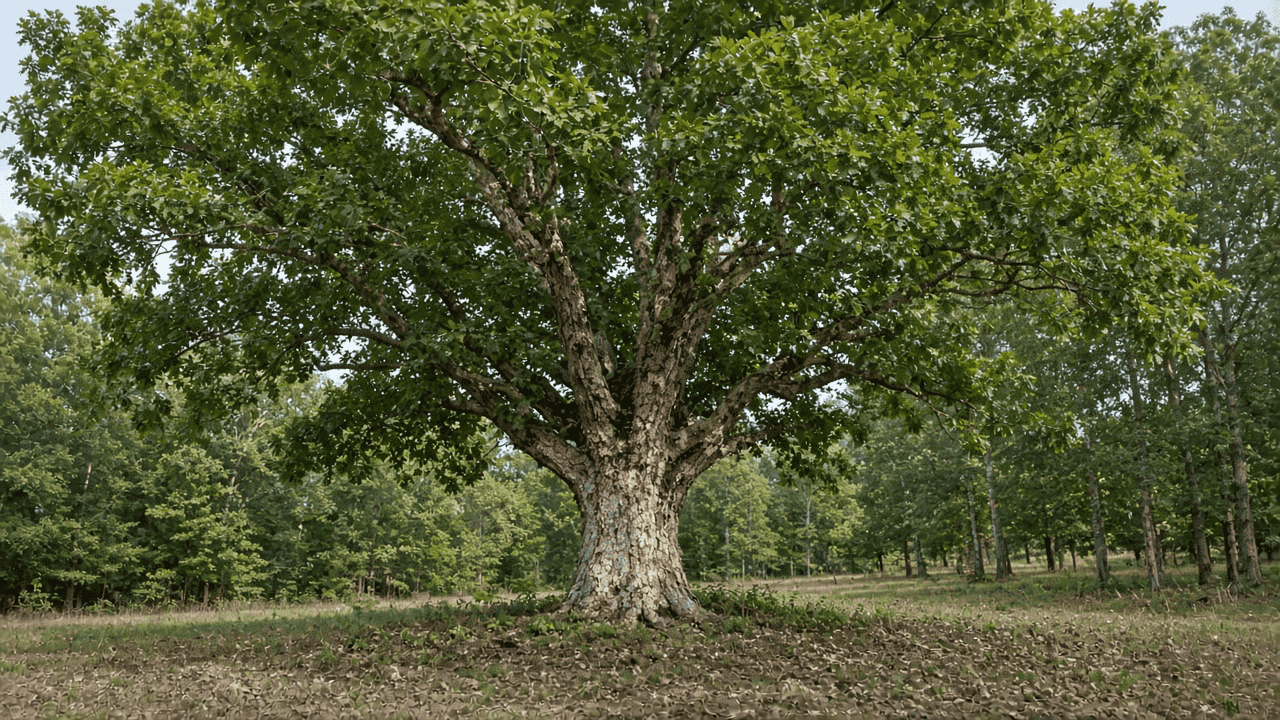
Pass the species when several sun leaves show fairly even rounded lobes without bristle tips, the acorn is short-stalked with a warty cap over about a quarter of the nut, and the older trunk is light gray and flaky rather than deeply furrowed. Stop at the group, not the species, when the lobes are rounded but the leaf is cross-shaped, fiddle-shaped, or only shallowly toothed.
A pale trunk, a fall color, or a nursery tag is not the call. Shade leaves and young trees often lack the even lobes used in keys, and a harmless smooth-patch fungus can erase the flaky pattern on part of the bark. White oak tree identification stops at the group until those limits are checked.
How to recognize
-
Check lobe tips on several sun leaves. Pass the white oak group when every lobe is rounded and has no hair-like bristle. Stop the species if any lobe ends in a bristle. That tree is in the red oak group.
-
Read the outline. Pass toward white oak when the lobes and gaps are fairly even, the base narrows, and there is no cross and no single cut almost to the midrib under a much wider tip. Counts are often about 7–9 lobes on a leaf about 4–9 inches long, and both numbers vary. Stop at post oak when the blade is leathery and cross-shaped. Stop at bur oak when the leaf is fiddle-shaped with that deep middle cut.
-
Turn a leaf and find a ripe or last year’s acorn. Pass when the underside is pale but not densely felted, the nut is roughly 0.5–1 inch long on a short or absent stalk, and the bumpy cap stops about a quarter of the way down the nut. Stop at swamp white oak when the underside is densely hairy and the acorns hang on stalks often about 2–4 inches long. Stop at bur oak when a fringe of loose scales covers much more of a larger nut.
-
Use bark only as support. Pass when older bark is light ash-gray and breaks into flakes or plates, often with chunky blocks low on the trunk. Pause on a smooth patch. That patch is a fungus on dead outer bark, common on white oak and post oak, and it does not injure the tree. Several other white oaks share pale, flaky trunks.
-
In winter, use the twig. Pass when the end buds are clustered, blunt, reddish brown, and about 1/8–1/4 inch, and the twig has no corky ridges. Bark alone is a pause. Clustered buds confirm an oak, not the species.
-
Match the name to the agreement. Pass Q. alba when steps 1 and 2 agree and step 3, or a winter twig plus leftover caps, supports them. Pause at “white oak group” when fruit is missing and the lobes are shallow. Do not force the species onto a narrow street tree. Some trees sold as white oak are hybrids with English oak.
Rounded lobes only exclude the red oak group. The outline then excludes the cross, the fiddle, and a chestnut-oak leaf of shallow rounded teeth. The acorn separates white oak from swamp white oak and bur oak after the leaf has already looked close enough. Bark and buds keep a winter visit from becoming a guess. That order is white oak tree identification on the tree in front of you.
Keys built on sun leaves fail on shade foliage and on immature trees. A mismatched leaf low in the crown is a reason to sample higher, not a reason to rename the tree.
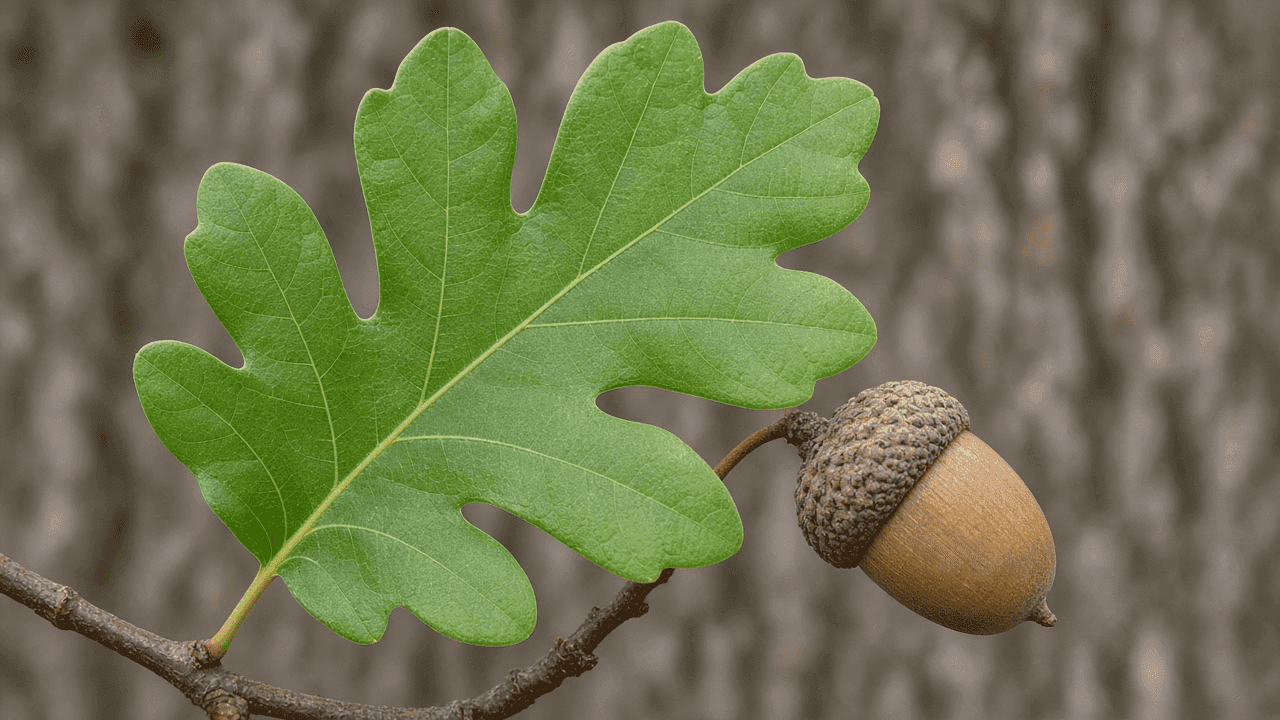
A photo, including the illustration below, cannot replace sun leaves and an acorn or cap from the tree in front of you.
The frame below is an editorial illustration of a rounded-lobe leaf and a short-stalked acorn. It is not a voucher specimen and is not enough to confirm an identification.
Similar species
| Name | Safe? | One difference |
|---|---|---|
| Northern red oak (Quercus rubra) | Not assessed | Lobe tips bristle-pointed; acorns take two seasons |
| Bur oak (Quercus macrocarpa) | Not assessed | Fiddle-shaped leaf; fringed cap covers much of a large nut |
| Swamp white oak (Quercus bicolor) | Not assessed | Densely hairy pale underside; acorns on long stalks |
| Post oak (Quercus stellata) | Not assessed | Leathery cross-shaped leaf |
| Chestnut oak (Quercus montana) | Not assessed | Shallow rounded teeth, not deep even lobes |
| English oak (Quercus robur) | Not assessed | Petiole only a few millimeters; ear-like leaf base; acorns on long stalks |
The row people miss is bur oak. Both trees have rounded lobes, white oak sinuses vary from shallow to deep, and bark color overlaps. The fringed cap, or one deep middle sinus under a wide tip, is the split. English oak is the planted miss: bark and rounded lobes match, so check for a very short petiole and a clasping, ear-like base before you accept a yard tree as Q. alba.
At a glance
Identity
Form
Season and place
Care
Where and when
Q. alba is native from southern Maine and southern Quebec and Ontario west toward Minnesota and eastern Texas, and south to northern Florida. It grows in moist to fairly dry deciduous woods, usually on deeper well-drained loams, and also on thinner soils of dry upland slopes. Growth is poor on the driest shallow ridges and on poorly drained flats and wet bottoms. A swamp tree with long-stalked acorns is the wrong site for this species.
Acorns mature in one season and usually drop from late summer into autumn, then germinate soon after they touch soil. Red oak group acorns take two years, so a ripe crop every autumn supports the white oak group, not a species. A green nut in midsummer can still be white oak. An empty crown in winter is normal. Catkins that open with the leaves, and fall color from brown to wine red, are shared widely enough that neither one breaks a tie.
Care guide
Plant only where the crown can become broad. Landscape heights are often about 50–80 feet, old forest trees can pass 100 feet, and published spreads run about 50–100 feet. Trunks flare and can lift pavement in a narrow tree lawn. Give full sun to partial shade and moist, well-drained soil. Wet sites are a poor match. Established trees handle a range of textures and are moderately drought tolerant once the taproot is down.
Transplant small, in spring if you can. The taproot makes a large move unreliable. Water a new tree, and keep traffic and fill off the roots, which extend past the dripline. Compacted soil is a common way established oaks decline.
Prune in the dormant season. Fresh summer wounds can draw the beetles associated with oak wilt. Leave cosmetic cuts until dormancy. A hazardous summer limb is a disease decision, not a shaping job. Acorns near walks are a siting problem, not a reason to top the tree. Growth is slow to moderate, so this is a long-lived shade tree, not a fast screen. Hardiness lists commonly run from zone 3 into zone 8 or 9 and do not share one endpoint. Use a local list at either edge of that span.
Horses and acorns
North Carolina Extension treats the plant as poisonous, including as a problem for horses, and names leaves and seeds as the poisonous parts. Gallotannins are the stated toxic principle. Do not treat a heavy acorn crop as harmless browse in a paddock. Wildlife eats the nuts, and people have leached tannins before eating them, but that history is not a feeding plan for horses and it is not a kitchen recipe.
History
On a living tree, “white oak” should mean Q. alba only after the checks above. In a lumberyard it usually means the white oak group: ring-porous oak whose earlywood pores are packed with tyloses. A board cannot be named with this leaf key. If the question is the wood, use the oak wood identification checks on end grain. Chestnut oak sits in that timber group even when its pores stay open.
Nurseries repeat the split. Crimson Spire and Streetspire are English oak crossed with white oak and were selected for a narrow crown. A columnar tree with “white oak” on the tag can be that cross. Read the leaves and the fruit. Do not inherit the species from the marketing name.
FAQ
Can bark alone name a white oak?
No. Light gray flakes support the call only after the leaves or the acorns agree. Smooth patch and several other white oaks share pale bark.
What if the tree is leafless?
Clustered blunt buds keep it in the oaks. Last year’s caps support white oak when they are warty, not fringed, and not on long stalks. Without those caps, wait for leaves.
Are the acorns safe to eat raw?
No. They are less bitter than many red oak acorns, and people have leached them, but this page does not give a method. Leaves and raw nuts are the poisonous parts named for horses and people.
Is a bristle-tipped “white oak” just a variant?
No. A bristle tip moves the tree into the red oak group. Rounded lobes are the gate, not a suggestion.