
Names and summary
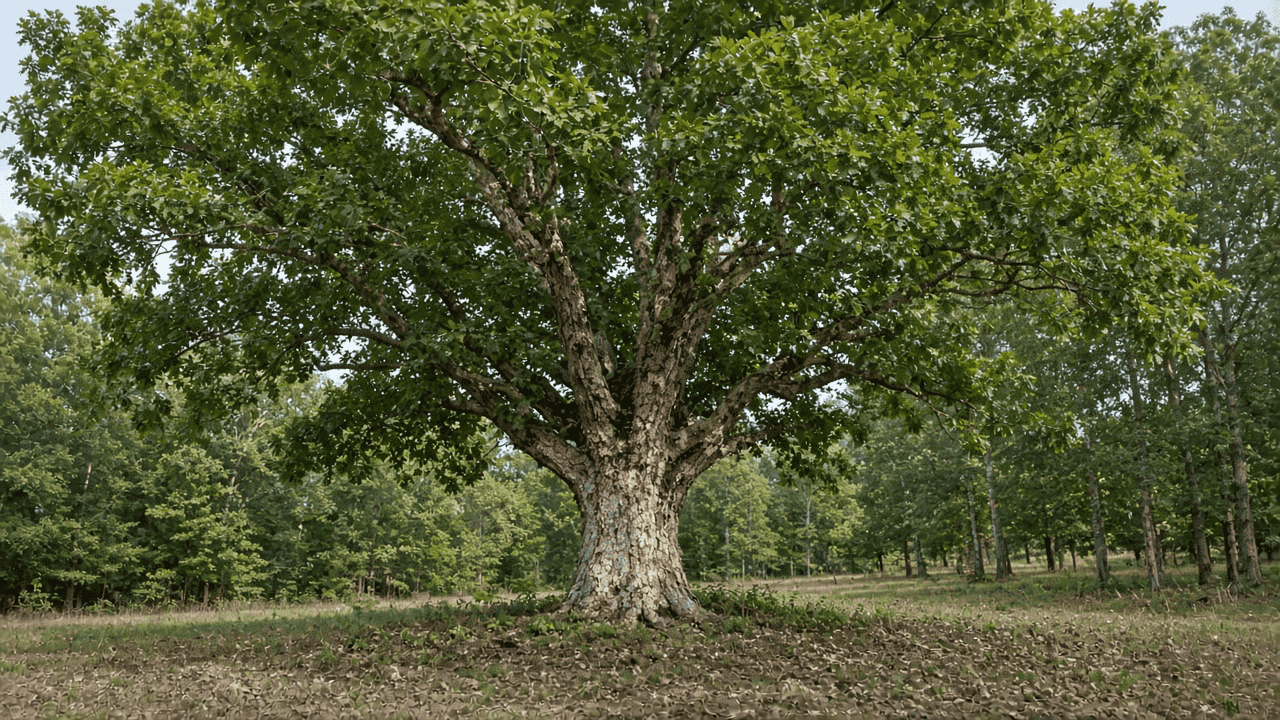
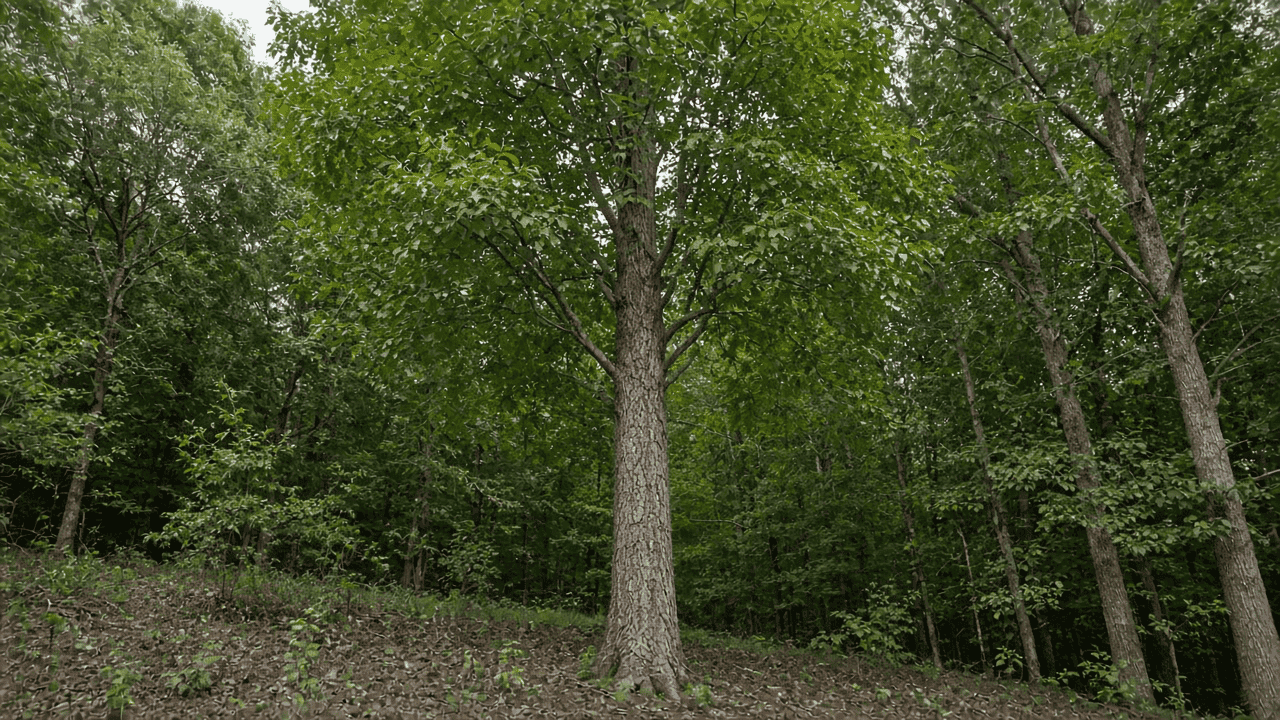
White ash tree identification is a leaf-and-twig call on Fraxinus americana, in the olive family. Pass it when the leaflets are stalked and plainly paler underneath, and a leaf scar is a deep U with the side bud sitting in the notch. Gray bark in diamond furrows does not finish the call. Once the trunk is mature, that bark matches green ash.
The common name follows the pale leaflet underside, not a white trunk. Biltmore ash is the other name trap. Some floras still place Fraxinus biltmoreana inside F. americana. Missouri treats Biltmore ash and Sullivan’s ash (F. smallii) as separate species that do not interbreed, because their chromosome numbers differ, and both have leaf scars notched more shallowly than white ash. Chromosomes are not a field character. A shallow scar means you stop at ash.
Flowers are usually male or female on separate trees, small, and without petals, so a crown with no fruit is ordinary. Published accounts disagree on whether those flowers open before, with, or after the leaves. Do not schedule the visit around bloom.
How to recognize
-
Check arrangement on two nodes, not one. Pass when leaves and twigs stand opposite. Stop if the leaves are alternate: tree of heaven, walnut, hickory, and mountain-ash fail here. Stop if a pair of stout prickles sits at the node. That is prickly ash, not Fraxinus. One missing mate is ordinary, because buds and limbs die.
-
Count a whole leaf. Pass when it is pinnate, about 8–12 inches long, with about five to nine stalked leaflets, often seven, and the edges are entire or only shallowly toothed. Stop if every leaflet meets at one point. That is a buckeye. Stop if the side leaflets have no stalks. That is black ash, or a planted European ash, which lacks the tufts of tan or reddish hair black ash has at each leaflet base.
-
Flip a fresh leaflet. Pass when the underside is plainly paler or whitish, often with a waxy bloom, and the upper side is green. Stop the white-ash name when both sides are a similar green. That is the green-ash pattern. Pause if the contrast is weak or the leaf is dry. One dendrology sheet only calls the underside slightly paler, so a mild difference is not a pass.
-
Use the leaf scar as the tie-breaker, and as the winter check. Pass when the scar is deeply notched, like a horseshoe, and the lateral bud sits in the notch. The terminal bud is large and brown, and it sits beside the upper pair of side buds. Stop when the scar is flat or only slightly hollow across the top and the bud sits on it. That is green ash. Stop when opposing scars meet in a V and hide the side buds. That is boxelder, even if the leaflet count overlaps an ash.
-
Read fruit only when the tree has it. Pass when the samaras are single, about 1–2 inches, paddle-shaped, with a plump seed at the handle end. Stop if the keys are paired: boxelder. Stop if the cluster is small apples: mountain-ash. Pause with no fruit. The species is usually dioecious, and seedless ashes are common.
-
Set the name only as hard as the evidence. Pass white ash when steps 1 through 3 agree and step 4 confirms them, or when the leaves are gone and step 4 is clear on its own. Stop blue ash when young twigs are strongly four-sided. Bark diamonds, a purple fall color, and a flowering date do not carry a step.
Opposite compound leaves only separate this group from most other hardwoods, and they still include boxelder. A whitened underside removes many green ashes and fails on a dull leaf. The scar still works in winter and on a tree with no fruit. That order is white ash tree identification on the tree in front of you.
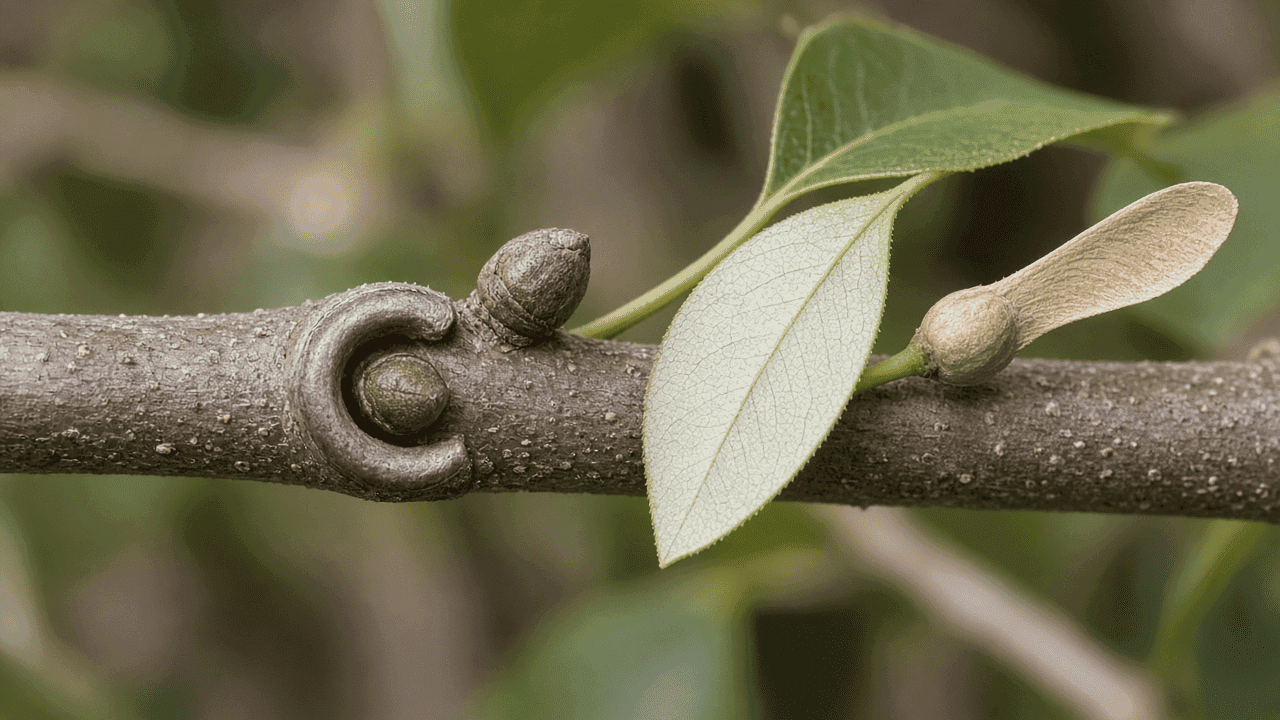
A photo, including the illustration below, cannot replace the leaf scar and a fresh leaflet on the tree in front of you.
The frame below is an editorial illustration of a U-shaped scar, a pale leaflet underside, and a single paddle samara. It is not a voucher and is not enough to confirm an identification.
Similar species
| Name | Safe? | One difference |
|---|---|---|
| Green ash (Fraxinus pennsylvanica) | Not assessed | Scar flat or shallow across the top; undersides not whitened |
| Black ash (Fraxinus nigra) | Not assessed | Side leaflets unstalked; terminal bud set apart from the side buds |
| Blue ash (Fraxinus quadrangulata) | Not assessed | Young twigs strongly four-angled |
| Boxelder (Acer negundo) | Not assessed | Samaras paired; leaf scars meet in a V and hide the buds |
| Tree of heaven (Ailanthus altissima) | Not assessed | Leaves alternate, often 11–41 leaflets; seed near the middle of the wing |
| Mountain-ash (Sorbus) | Not assessed | Fruit is a cluster of small pomes, not a single samara |
The row people miss is green ash. Mature bark matches, both species are planted in yards, and bottomland versus upland is only a hint. Use the underside when it is obviously whitened. When the contrast is weak, the scar decides.
At a glance
Identity
Form
Season and place
Care
Where and when
Wild trees run from Cape Breton Island, Nova Scotia, to northern Florida, and west to eastern Minnesota and eastern Texas. Best growth is on fertile, moist, moderately well-drained soils, about pH 5.0–7.5, on lower and middle slopes. It is usually upland rather than swamp, though it tolerates brief flooding, and a New England wetland code rates it as mostly non-wetland. Yard and street trees ignore that map, so white ash tree identification still uses the scar.
Winter removes the underside, so the scar has to stand alone. A high crown hides that scar. A fallen leaflet can show the pale surface and still cannot show the notch. Fall color runs from yellow into orange, red, or purple on some trees, and green ash is described as bright yellow, but yellow occurs on both, so color never splits them. A dead top or flaked bark can be emerald ash borer on any true ash. That is stress, not a species mark.
Care guide
After the name is set, give the tree full sun to partial sun on rich, moist, well-drained soil. A planting note places it in zones 4 to 9 and treats it as less forgiving than green ash of long drought, occasional flooding, and very alkaline soil. In the open it is often about 70 feet tall and about 50 feet wide, so keep it off wires and off a wall. Female trees drop samaras. Compacted soil can push roots to the surface, and narrow crotches can split in storms.
Emerald ash borer can kill a healthy ash. A federal page updated in April 2026 reports detections in 38 states and the District of Columbia. The beetle was first found in southeast Michigan in 2002. A thin top is not enough to buy a treatment. Look for at least two clues, because dieback has other causes: a D-shaped exit hole about one-eighth inch across, S-shaped or serpentine galleries under the bark, and woodpeckers flecking the outer bark, often high in the crown. Round or oval holes fit native borers. Retail products exist, and successful insecticide treatment is still described as limited. Ask a local extension office whether that tree is worth treating. Professional work is often expensive, and many owners remove the tree instead. This page does not give a dose, and a new white ash is a poor long-term street tree where the beetle is already established.
Do not move firewood
People move the beetle in firewood, logs, and nursery stock. Buy local firewood, or firewood that has been certified heat-treated. The federal domestic quarantine ended on 14 January 2021, so there is no longer one national movement ban, but infested wood still spreads the insect. Check the local rule before you haul logs.
Ecology
Feeding under the bark can thin the top within one to three years and push sprouts out lower on the trunk. A ragged crown can still be white ash when the scar matches. Samaras feed wood ducks, bobwhite, purple finches, pine grosbeaks, and fox squirrels. Seedlings persist in deep shade and grow little there. Older trees need light and are classed overall as intolerant, so a shaded sapling is a light problem, not a different species.
FAQ
I only have a board or a stump. Can I finish this call?
No. Opposite twigs and paddle samaras are gone once the wood is milled. End-grain checks for ash versus oak are a different task, on the oak versus ash wood page. A stump can still show diamond bark, which white ash shares with green ash, so the stump alone stays at ash.
A nursery label says white ash. Is that enough?
No. Read the scar and a fresh underside. Green ash was widely planted after elms died, and it grows faster, so a yard ash is often that species. A Biltmore or Sullivan’s ash can also carry an older white-ash name while the scar is only shallow.
Is mountain-ash the same beetle problem?
No. Mountain-ash is a Sorbus, and prickly ash is not a Fraxinus. The beetle attacks true ashes, including white, green, black, and blue ash. A name with “ash” in it is not the host list.